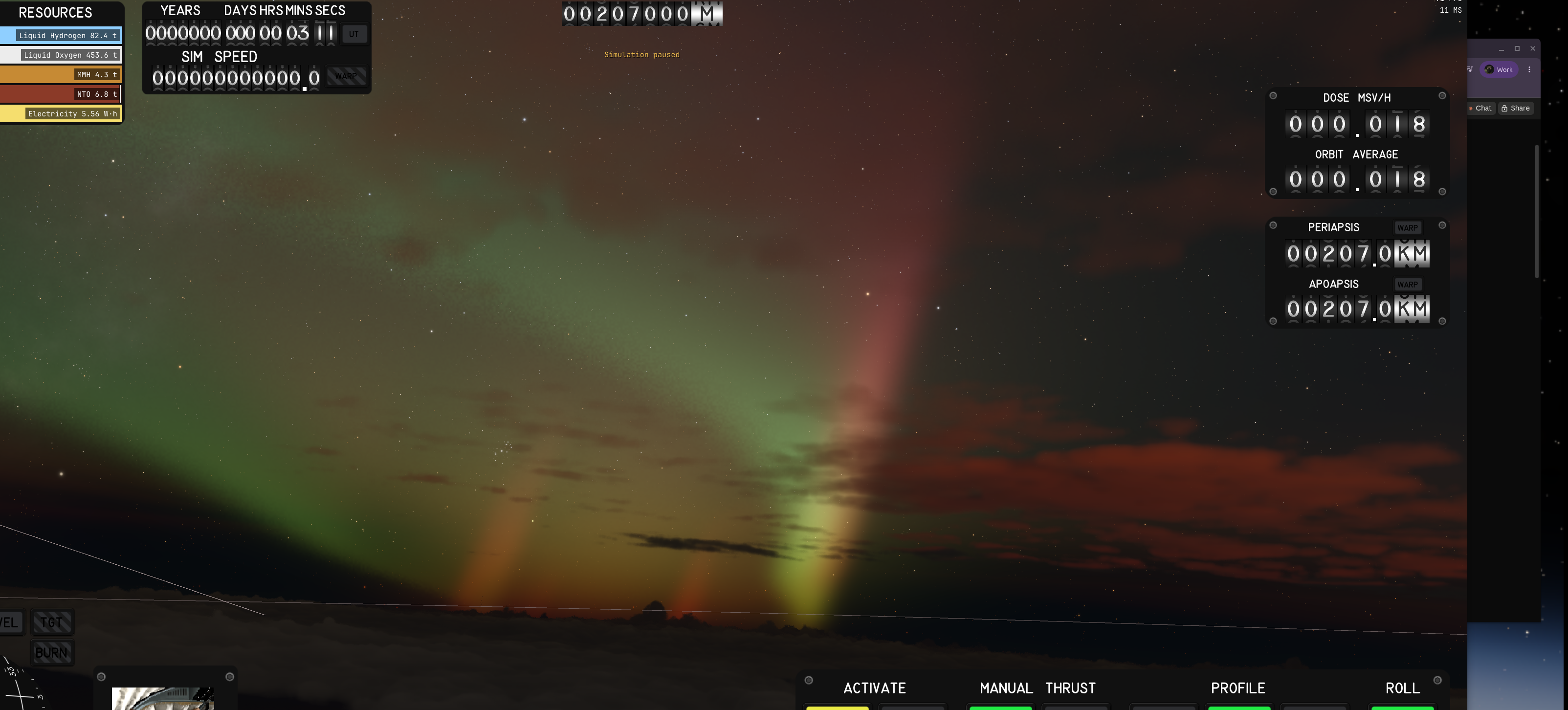
Space in KSA now has weather. Planets with a magnetic field carry radiation belts, the star blows a wind of particles that squeezes them, and Earth's skies light up with aurora.
This opens up potential for a whole range of new gameplay mechanics.
Radiation on Kittens and having to manage their radiation exposure. This provides a lot of new mechanics that could be introduced. Having to heal them over time, etc.
Radiation impacting electronics (probes), etc.
Radiation impacting communications.
and so on..
Radiation and it's effects are pretty hard core and will probably end up being a game difficulty setting.
Radiation
Every vehicle now has a radiation dose rate shown on a new Radiation gauge in the UI. It reads the current dose and the average over the current orbit in millisieverts per hour. The dose itself comes from three places:
The star's particle wind. Falls off with the square of distance, and halves when a planet is between you and the star.
Cosmic rays. A steady background from outside the solar system itself and harder to deflect than the star's particles.
Radiation belts. Particles trapped by a planet's magnetic field in two doughnut-shaped belts.
A magnetic field shields you from the first two, and the air overhead shields you from all three, so being on the surface of Earth, for example, is safe.
Just like in the real world, because the magnetic field on Earth is tilted and off-centre, the inner belt dips closer to the surface over one patch of the planet. Low orbits clip it there, just as real low orbits clip the South Atlantic Anomaly in real life.
Magnetospheres and the solar wind
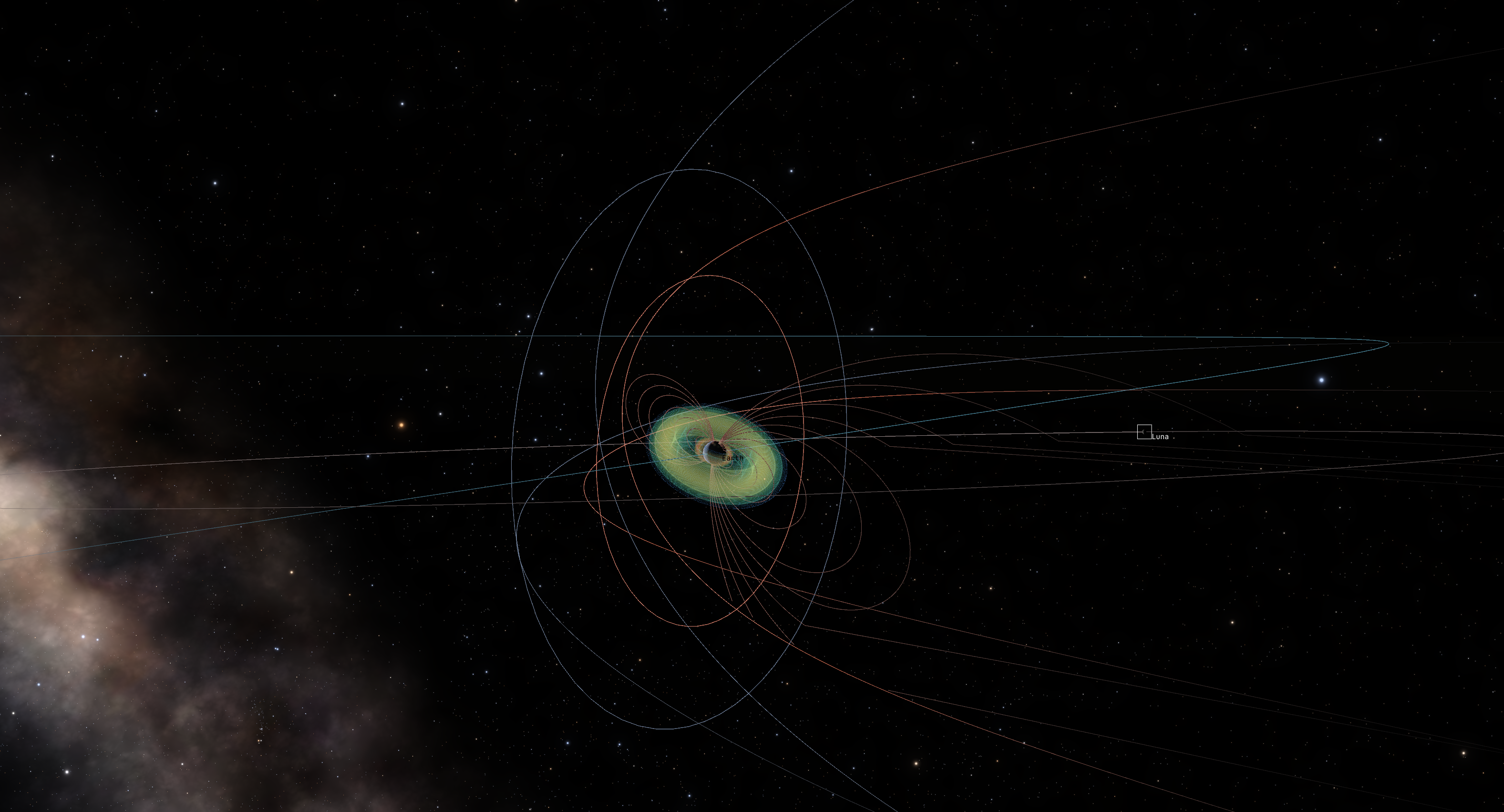
Six planets have a magnetosphere: Mercury, Earth, Jupiter, Saturn, Uranus and Neptune. The magnetospheres are defined via data in the body's XML, so modders can give a world deadly belts or none at all. Each field is placed by where its north pole leaves the surface, plus an offset from the planet's centre. Earth's pole sits at about 80.7° N, 72.7° W.
The star's wind pushes on the field. Where the wind's pressure balances the field the magnetosphere ends at the magnetopause, which for Earth comes out at about 10 Earth radii on the day side. So the belts aren't fixed shells. They are squashed on the side facing the star and stretched into a tail on the night side.
The squeeze matters most in the outer belt. Without the wind, geostationary orbit would take about 2.6 mSv a day; with it, about 3.5. The inner belt sits deep enough that the wind barely moves it.
The currently defined numbers are a first pass. Earth's have had one round of tuning. The other planets' are approximate and their belt doses are placeholders until we balance them.
Seeing it in the map
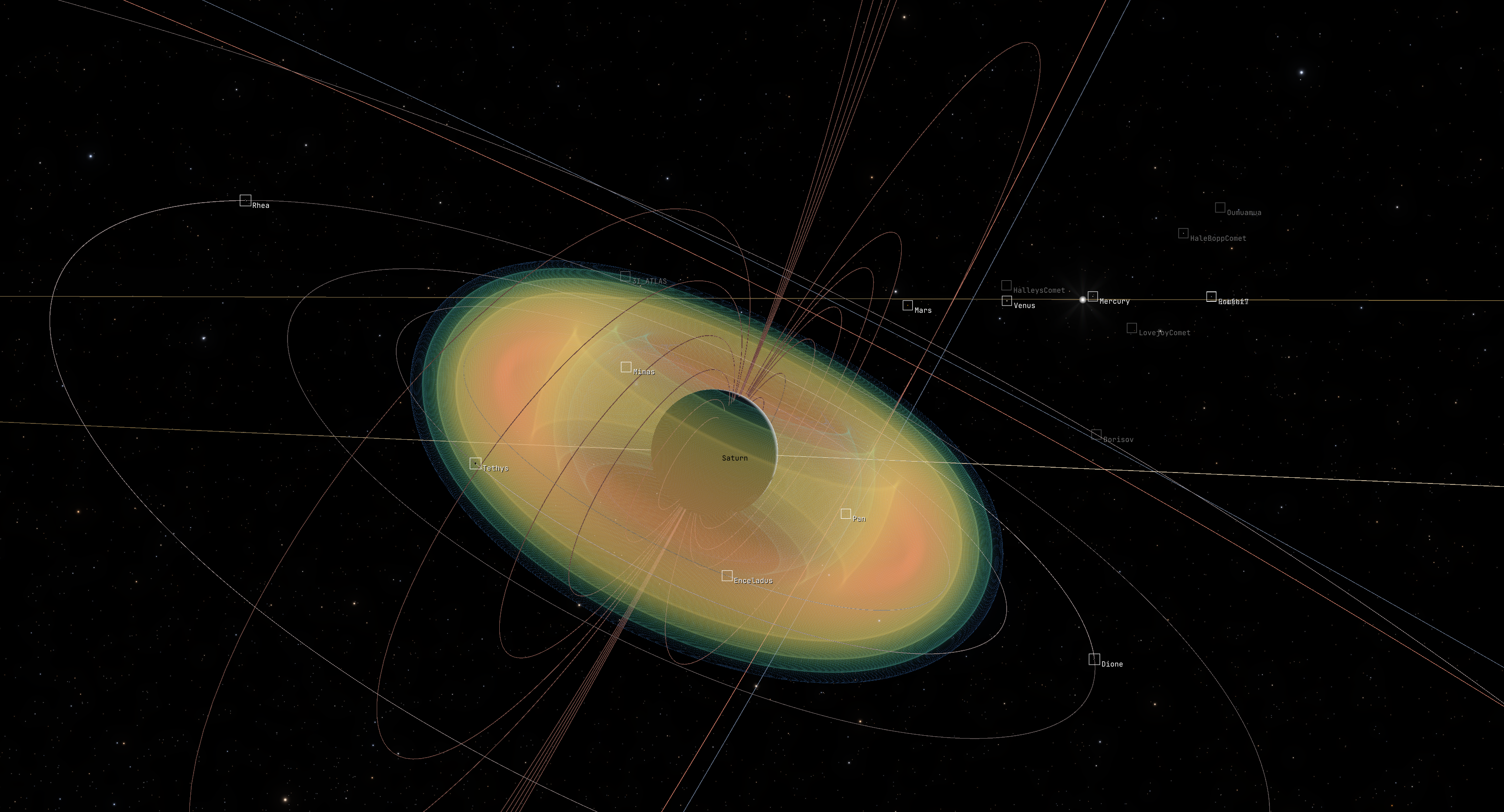
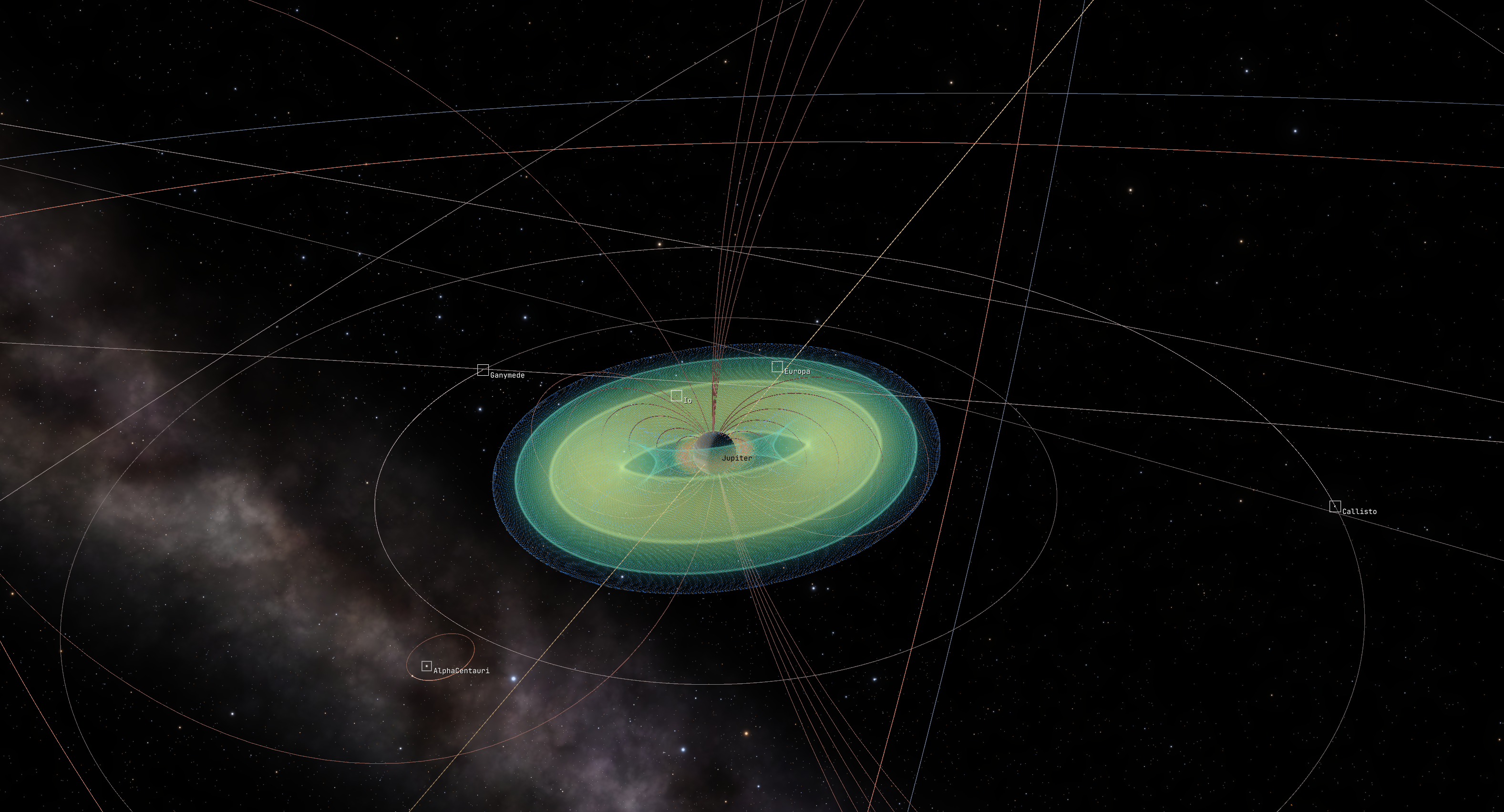
The Map View window has a new Magnetospheres toggle which is toggled off by default. Turn it on and every magnetised planet draws:
its radiation belts as a shaded volume with contour lines marking the dose levels.
its closed field lines showing the tilt.
the tail stretched out behind it.
the magnetopause and the bow shock in front of it.
All of it follows the star's wind, so you can see the day side squashed and the night side drawn out. It's the quickest way to check whether a planned orbit runs through the belts.
Aurora
Earth now has aurora. A glowing oval around each magnetic pole, at about 65–70° magnetic latitude. It is drawn from the same magnetic field as the belts so the two always agree and it shows on the night side.
The glow lives between 90 and 400 km. Green dominates from about 100 km and fades with height. A fainter red takes over above 200 km. Folds, ripples and vertical rays run along the oval and drift over time.
You can see it two ways:
From orbit as the classic ring around the pole, drawn over the cloud tops so the clouds don't dim it.
From the ground at high latitude as curtains overhead.
The aurora is rendered inside the existing atmosphere pass. If you're PC is a little low on the specs side, the new Aurora option under Graphics > Volumetrics turns it off. It is on by default.
What's next
So far radiation is something you can see and measure but it doesn't hurt anyone or anything yet. The next two steps make it matter: crew dose, then space weather.
Next | What it adds | Waiting on |
|---|---|---|
Crew dose | Each kitten tracks a short-term dose that heals with rest and a lifetime dose that never does. Too much short-term dose brings sickness; too much lifetime dose ends a career. Dose bars on crew portraits and columns in the roster | Whether dose can kill or only grounds kittens, and whether it shares a health model with life support.. Ideas for other crew dose management, EG: in-situ medical facilities? |
Vehicle shielding | Mass between the crew and space cuts the dose and full tanks count, so a propellant or water wrap around the cabin works. A dedicated shield part, and a shielding figure in the editor. | Crew dose. |
Safe time warp | Warp stops before a kitten crosses a dangerous dose, the same way it stops for other hazards. | Crew dose. |
Solar cycle and particle storms | Stars get an activity level that rises and falls. Rare solar storms hit at 100 to 1000 times the normal dose for a day or two, with a warning alert hours ahead. A planet's shadow or a deep magnetosphere keeps you safe. Open space doesn't, which makes a storm shelter worth carrying? | Design of the storm schedule, which must play out the same at any warp speed. How much these could wreak havoc with mission planning and gameplay fun. |
Brighter storm aurora | During a storm the oval widens, pushes toward the equator and brightens | Solar storms |
Dose on the orbit readout | Predicted dose per orbit beside Ap and Pe in the map, so belt exposure can shape orbit choice | Deciding whether belts are a real constraint or flavour |
More aurora | Aurora on the gas giants, with their own colours | Aurora cost |
Probe electronics | High dose can glitch or reset an uncrewed probe, hardened parts resist it | Optional, after storms |
Balancing | Real belt doses for Mercury and the giants, and cosmic rays that rise beyond the edge of the star's wind for interstellar trips | Test flights |